Whamit!

The Weekly Newsletter of MIT Linguistics

Archive for the ‘Alumni News’ Category

Omer Preminger in NLLT

A new paper has just appeared in Natural Language and Linguistic Theory by Omer Preminger (PhD 2011, postdoctoral fellow with Masha Polinsky at Harvard and a visiting faculty member here). It is called “Asymmetries between person and number in syntax: a commentary on Baker’s SCOPA”. The abstract describes its contribution as follows: “In this commentary, I explore Basque data that counter-exemplifies SCOPA, as well as a handful of other empirical patterns that SCOPA fails to address, but which I believe should be treated as part of the same empirical landscape. But far from condemning SCOPA, I believe these additional patterns may provide us with hints regarding how SCOPA (with its considerable empirical coverage), as well as its exceptions, are to be derived.”

Congratulations, Omer!!

Joseph Aoun receives Muh Award

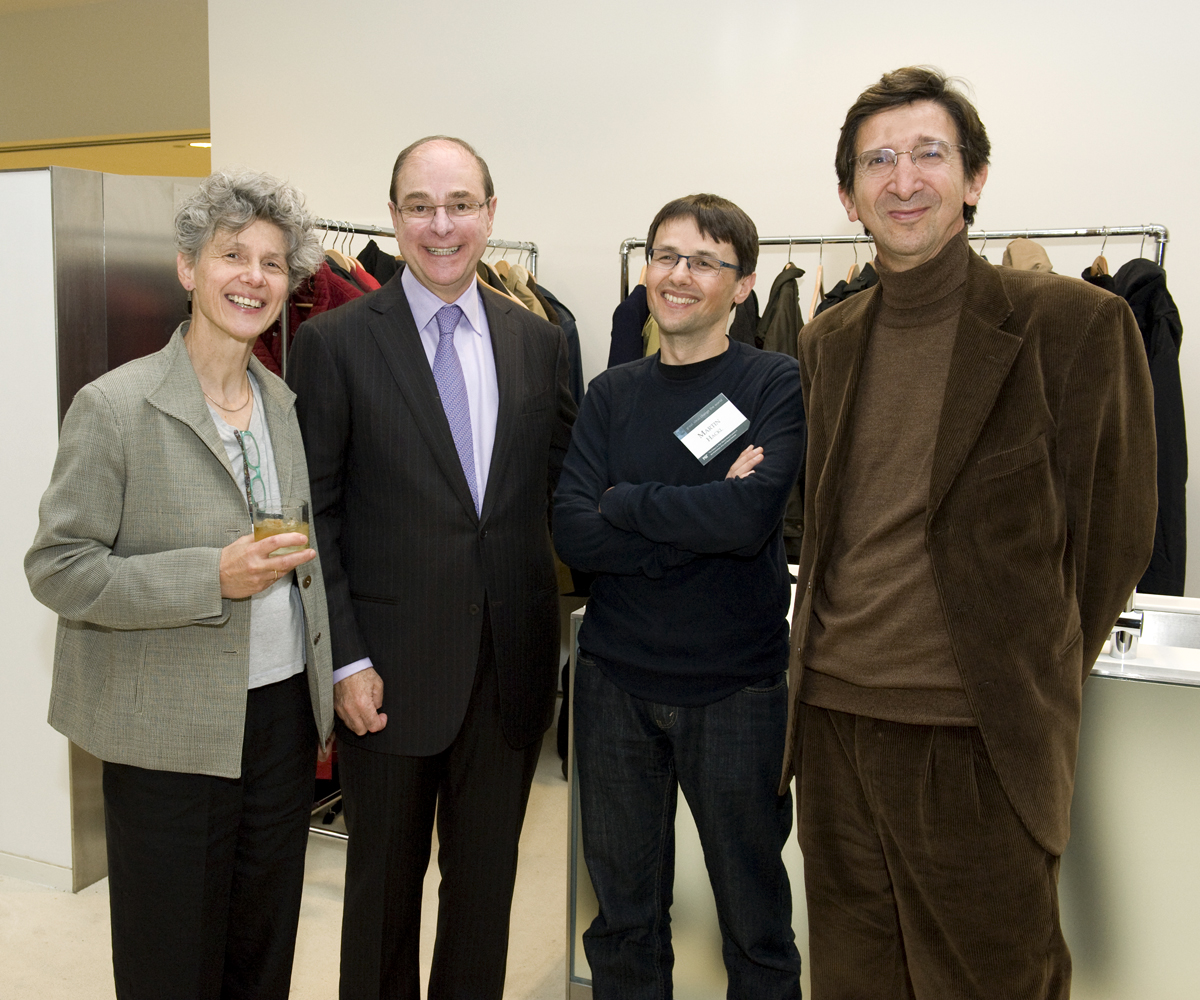
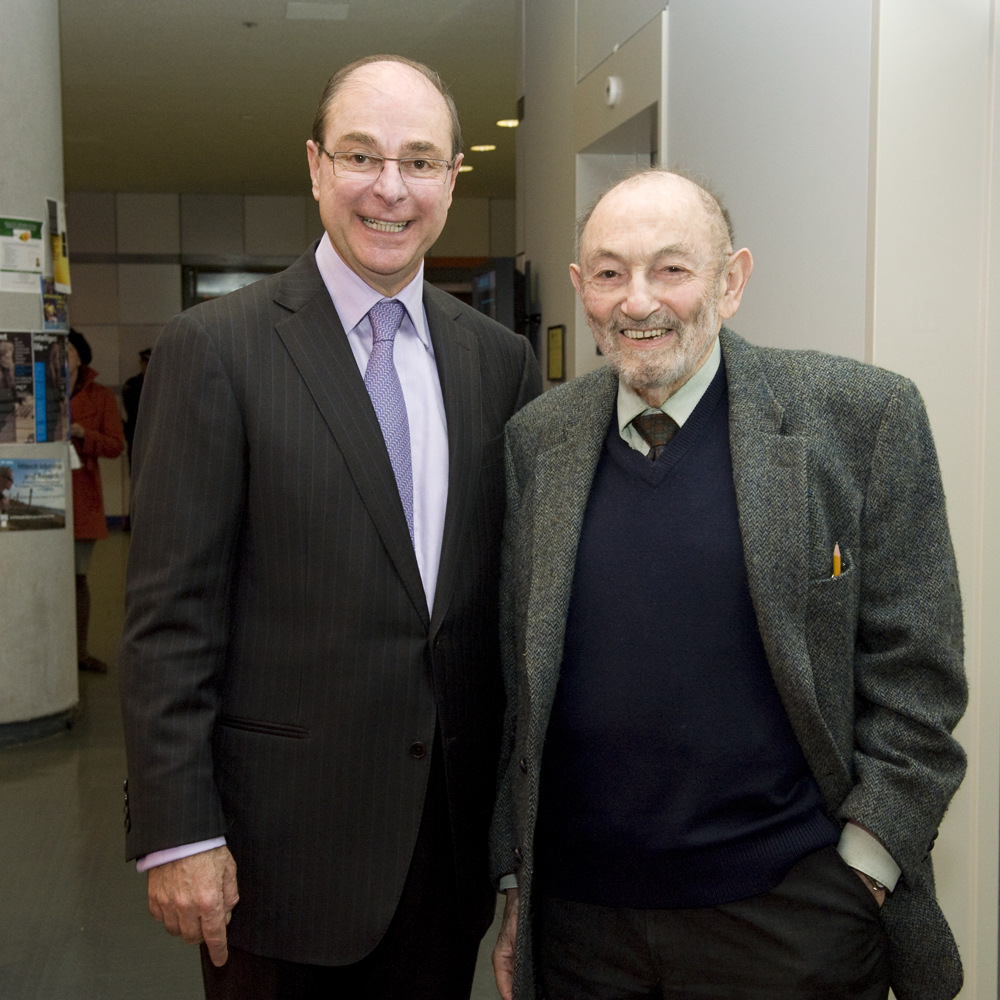
Joseph Aoun, 1982 Linguistics PhD, eminent syntactician, and President of Northeastern University, received the 2011 Robert A. Muh Alumni Award last Wednesday. The award (created by Robert Muh (SB ‘59) to honor the 50th anniversary of the the School of Humanities, Arts and Social Sciences) is presented every two years to an MIT alumnus who has made “made extraordinary contributions during a career in the arts, humanities, or social sciences”.

The award was presented by Deborah Fitzgerald, Dean of the School, who praised Aoun for his “outstanding contributions to the field of linguistics as well as educational leadership”. Introducing Joseph, David Pesetsky noted the ways in which his research had repeatedly uncovered “a deep unity between subsystems of grammar thought to be distinct”, and read a letter of congratulations from Noam Chomsky, who described the award as a “well-deserved honor for your remarkable contributions, not only to our own field but to the general intellectual and academic community”. David also noted that Joseph was an outstandingly distinguished member of an outstandingly distinguished PhD class that entered in 1978, three members of which (Prof. Carol Neidle of Boston University, James Huang of Harvard and our own Donca Steriade) were present in the hall. Joseph’s Muh Alumni Award Lecture, which followed the presentation of the award, had the rather non-linguistic title “The Future of American Higher Education in the Global Knowledge Marketplace” — but in fact began with a very personal intellectual autobiography that described some of the links between Joseph’s career in linguistics and his decision to enter university administration. It was interesting, engaging and at times moving event (video here). Congratulations Joseph Aoun!

(photographs by Richard Howard)

Early Career Award from LSA for alum Seth Cable

We were ecstatic to learn that Seth Cable (PhD 2007) has won the 2012 Early Career Award of the Linguistic Society of America. This award (inaugurated in 2011) goes each year to “a new scholar who has made an outstanding contribution to the field of linguistics.” Seth’s dissertation, which was the source for his recent book The Grammar of Q (Oxford University Press) presents a theory of the syntax and semantics of wh-questions in which pied-piping effects arise without any actual notion of pied-piping in the grammar — a proposal about the structure of languages in general suggested by Seth’s own fieldwork on Tlingit, a Na-Dené language of Alaska. After MIT, Seth spent a post-doctoral year as a Killam Fellow at the University of British Columbia, and is now an Assistant Professor of Linguistics at UMass Amherst, where his current work explores many aspects of semantics and syntax in a wide variety of languages. Congratulations Seth!!

Banting Fellowship for Jessica Coon

Jessica Coon (PhD 2010), who we earlier announced has accepted a tenure-track Assistant Professor position at McGill University, has also been awarded a Banting Post-Doctoral Fellowship, which will allow her to begin her career at McGill with two years devoted mainly to research.   Described informally by a colleague as “the Nobel prize of post-docs”, the goal of the Banting fellowship program is “to attract and retain top-tier postdoctoral talent, both nationally and internationally, to develop their leadership potential and to position them for success as research leaders of tomorrow”.  As a Banting Fellow, Jessica will be collaborating with McGill’s Lisa Travis (MIT PhD 1984) on an investigation of an array of surprising syntactic parallels between Mayan and Austronesian languages. Congratulations Jessica!

Maria Babyonyshev

We are deeply saddened by the news that our former student and colleague in linguistics Maria Babyonyshev has died at the untimely age of 44, from complications of a devastating 2006 car accident. Masha received not one, but two degrees from MIT. She received her undergraduate degree in linguistics from MIT in 1990 (Phi Beta Kappa) and her PhD from our department in 1996, with a dissertation entitled Structural Connections in Syntax and Processing: Studies in Russian and Japanese. In fact, the word “connections” aptly describes Masha’s entire varied and influential research career, which steadfastly and continually charted and explored the links between linguistic theory, language acquisition and processing - as well as the links between the structure of her native language, Russian, and the other languages of the world. In her own papers and her many collaborations, Masha made some of the most interesting and cleverest connections we know between the theoretical and experimental sides of linguistics. Most recently, working with students and colleagues at Yale (where she was a member of the linguistics faculty) Masha had started investigating a striking pattern of language impairment widespread in one village in the Arkhangelsk region of Russia. As a researcher, as a member of our field, and as a friend, she will be badly missed.

Masha’s family writes us that they are “creating a fund to complete a project that Masha was pursuing over the last year out of her love of plants, flora and trees. The Antonovka Apple was her favorite apple growing up in Russia, but it is rarely used as an eating apple here and therefore is essentially not grown. She had recently imported seeds of the apple and was working on the plant science of growing seedlings. We wish to hire a plant scientist and nursery to complete the project and provide seedlings to our friends and family to plant where they would like. Masha’s living legacy will be the trees and apples. Please send contributions to: The Antonovka Fund, c/o Ted Walls and Nadia Babyonyshev, 67 Prospect Avenue, North Kingstown, RI 02852.”

Jessie Little Doe Baird receives MacArthur genius grant

Jessie Little Doe Baird (SM, MIT Linguistics 2000), of the Wôpanâak Language Reclamation Project, has received a MacArthur “genius grant”. Background info on Baird appears in a 2008 article in the Technology Review. There is a nice video prepared by the MacArthur Foundation, a Boston Globe article, a couple of paragraphs in an MIT News item, which includes quotes from Norvin Richards, who continues Ken Hale’s work with the project: http://web.mit.edu/norvin/www/wopanaak.html. Here are Norvin’s remarks in full:

This award recognizes many years of enormously hard work in pursuit of a dream. It’s hard to imagine a better person to receive this grant! I joined the project in 1999 when I joined the faculty here; at that point, joining the project meant meeting regularly with Jessie and Ken in Ken’s office, poring over 17th-century Wôpanâak texts to try to understand what they could teach us about the grammar and vocabulary of the language. I am honored to still be part of the project today, working together with Jessie on a dictionary, a textbook, and a variety of other educational materials. Today, the project offers language classes at a variety of levels, staffed by Jessie and by her former language students, culminating in a summer Immersion Camp at which only Wôpanâak is spoken. Children are beginning to acquire the language as well, including Jessie’s own daughter Mae Alice Baird, raised by Jessie and her husband Jason entirely in Wôpanâak.

The world is currently in the middle of a massive wave of language extinction. Some linguists estimate that 90% of the world’s languages will vanish in the coming century. The indigenous languages of America are particularly hard hit. Against that backdrop, the success of the Wôpanâak Language Reclamation Project is a rare piece of good news. If Jessie succeeds, she will have shown that for languages, ‘death’ is not permanent; with enough dedication and hard work, as long as a language is sufficiently well documented, we can hope to bring it back to life.